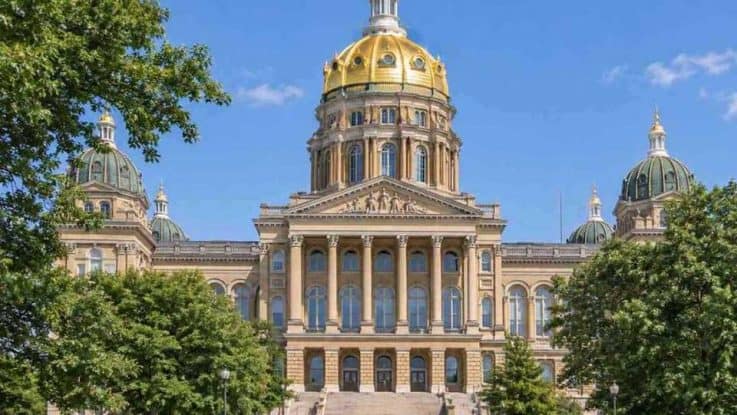
In short: On 3 April 2009 the Iowa Supreme Court ruled unanimously in Varnum v. Brien that the state’s law limiting marriage to a man and a woman violated the equal protection clause of the Iowa Constitution. Same-sex couples could marry from 27 April 2009, making Iowa the third state to allow it and the first in the Midwest. Voters removed three of the justices in 2010, but the ruling stood until national marriage equality in 2015.
Of all the posts on the original version of this site, the one about the Iowa ruling drew the most links from other websites. That reflects how unexpected it was. In early 2009 only Massachusetts and Connecticut allowed same-sex couples to marry, and California’s Proposition 8 had just ended marriages there. Then a unanimous court in a Midwestern state ruled the other way. This article explains the case, the reasoning, the backlash and the wider wave of change in 2009.

The case
The case began in December 2005, when Lambda Legal filed suit for six same-sex couples who had been refused marriage licences by the Polk County recorder, Timothy Brien. The lead plaintiffs were Katherine Varnum and her partner Patricia Hyde. In August 2007 Polk County District Judge Robert Hanson ruled in the couples’ favour. Several couples applied for licences the next morning and one couple married before he stayed his order pending appeal.
The Iowa Supreme Court heard argument in December 2008. Many organisations filed briefs, including the American Psychological Association, which summarised research on same-sex parents and their children.
The ruling, 3 April 2009
The court ruled 7 to 0. Justice Mark Cady wrote the opinion. Its central steps were these.
- Similarly situated. Same-sex couples were, for the purposes of marriage law, in the same position as opposite-sex couples: in committed relationships, raising children and sharing households.
- Heightened scrutiny. Laws that classify people by sexual orientation deserve closer review, because gay people had faced a history of discrimination for a trait unrelated to their ability to contribute to society.
- No sufficient reason. The county’s arguments, about tradition, child-rearing, procreation and resources, did not justify excluding same-sex couples.
- Religion and civil marriage. The court addressed religious opposition directly, saying civil marriage is a state institution and churches remained free to define religious marriage as they wished.
The remedy was simple: the words limiting marriage to a man and a woman were struck out, and the rest of the marriage law applied to everyone. CNN reported the decision as a landmark for the Midwest, and Minnesota Public Radio noted the immediate interest from couples in neighbouring states.
Why it mattered
Iowa mattered for three reasons. First, geography: it showed marriage equality was not only a coastal issue. Second, the unanimous vote by a court with justices appointed by governors of both parties made the ruling hard to dismiss as partisan. Third, Iowa had no residency rule for marriage, so couples from across the Midwest could travel there to marry.
The New York Times opened a debate the same day on whether courts or legislatures should decide who can marry. That argument ran through every case covered on this site, from the DC Council’s vote to the Supreme Court’s rulings on the Defense of Marriage Act.

Licences and weddings
The ruling took effect on 27 April 2009, after the period for a rehearing request passed. CBS News reported that couples lined up at county offices that morning. Iowa has a three-day waiting period, which judges could waive, so some couples married the same day. Hundreds of couples married in the first months, many from out of state.
The 2010 retention vote
Iowa judges face periodic retention votes. In November 2010 three of the justices who joined Varnum, Chief Justice Marsha Ternus and Justices David Baker and Michael Streit, were on the ballot. A well-funded campaign urged voters to remove them, and all three lost, the first time Iowa voters had removed a supreme court justice under the system.
The ruling itself was untouched. Efforts to put a constitutional amendment on the ballot failed in the legislature. In 2012 the three former justices received the John F. Kennedy Profile in Courage Award for upholding judicial independence. A 2012 retention campaign against Justice David Wiggins, another member of the Varnum court, failed.

The 2009 wave
Iowa was not alone. 2009 brought more change on marriage than any year before it.
- Vermont: on 7 April 2009 the legislature overrode the governor’s veto to pass marriage equality, the first state to do so by statute rather than court ruling.
- Maine: the legislature passed a marriage law in May 2009, but voters repealed it in November that year. Voters approved marriage in 2012.
- New Hampshire: a marriage law was signed in June 2009 and took effect on 1 January 2010.
- District of Columbia: the Council passed a marriage bill in December 2009.
- New Jersey and New York: Governor Jon Corzine of New Jersey backed a marriage bill, with public support from Broadway performers, but the state Senate rejected it in January 2010. New York’s Senate voted no in December 2009; the state passed marriage in 2011.

Key takeaways
- Varnum v. Brien was decided on 3 April 2009 by a 7 to 0 Iowa Supreme Court, with Justice Mark Cady writing.
- Iowa was the third state to allow same-sex marriage and the first in the Midwest; licences began on 27 April 2009.
- The court applied heightened scrutiny to a law classifying people by sexual orientation.
- Three justices lost retention votes in 2010, but the ruling stood.
- Vermont, Maine and New Hampshire also passed marriage laws in 2009, though Maine’s was repealed by voters.
Common questions
When did Iowa legalise same-sex marriage?
The Iowa Supreme Court ruled on 3 April 2009, and same-sex couples could marry from 27 April 2009.
Who were the parties in Varnum v. Brien?
Six same-sex couples, led by Katherine Varnum, sued Polk County Recorder Timothy Brien after he refused them marriage licences. Lambda Legal represented them.
Was the Iowa ruling unanimous?
Yes. All seven justices joined Justice Mark Cady’s opinion.
What happened to the Iowa judges?
Three of them lost retention elections in November 2010. They later received the John F. Kennedy Profile in Courage Award.
Which state was first to allow same-sex marriage?
Massachusetts, after its Supreme Judicial Court’s ruling in Goodridge took effect in May 2004. Connecticut followed in 2008 and Iowa in 2009.
How we wrote this: This summary is based on the court’s published opinion, news reports from April 2009 and later accounts of the retention vote. Quotes and dates were checked against those sources. Last checked November 2026.
Sources
- Justia: Varnum v. Brien, Iowa Supreme Court opinion (2009)
- CNN: Iowa court strikes down same-sex marriage ban
- MPR News: Iowa court says gay marriage ban unconstitutional
- CBS News: Iowa issues marriage licences to same-sex couples
- American Psychological Association: Varnum amicus brief
- JFK Library: 2012 Profile in Courage Award, Baker, Streit and Ternus
- New York Times: When a court decides who can marry
Leave a Reply